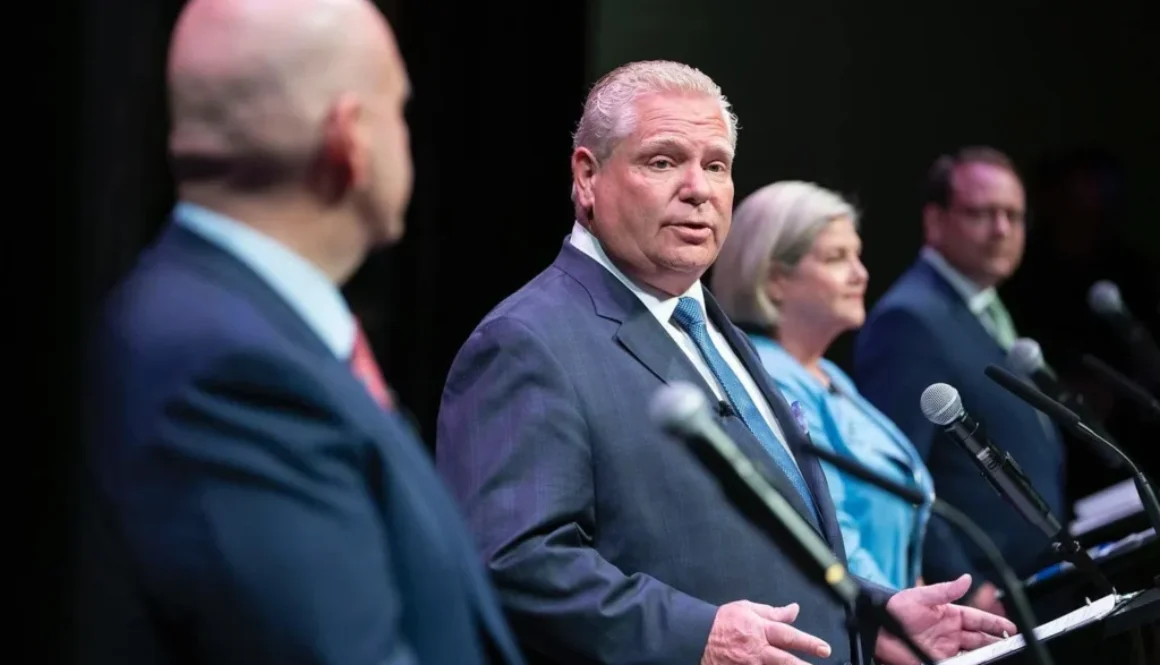
Ontario’s party leaders debated each other for the first time this election in North Bay.
The state of our highways was among the issues raised.
PC leader Doug Ford outlined the investments made and criticized Steve Del Duca when he was Transportation Minister under Kathleen Wynne’s government.
“Mr. DeLuca, you had your opportunity, and you failed. You were the Minister of Transportation. You didn’t build absolutely nothing, absolutely nothing,” said Ford.
NDP leader Andrea Horwath said the promises Ford was making this election as the same made four years ago and not acted upon.
“I have to say it’s pretty interesting when I know that some of the promises that Mr. Ford is making are the same ones that were in his last platform, and he hasn’t gotten around to those things,” said Horwath.
Ford shot back, calling Horwath anti-development.
“Miss Horvath, you’d be in the middle protesting with protest signs on the highway with all your protesters because your anti-development, you’re infrastructure. I’m about getting it done. I’m about building this province,” said Ford.
“You’re about your buddies, Doug,” retorted Horwath.
The debate was held as part of a gathering of municipal leaders from northeastern Ontario.
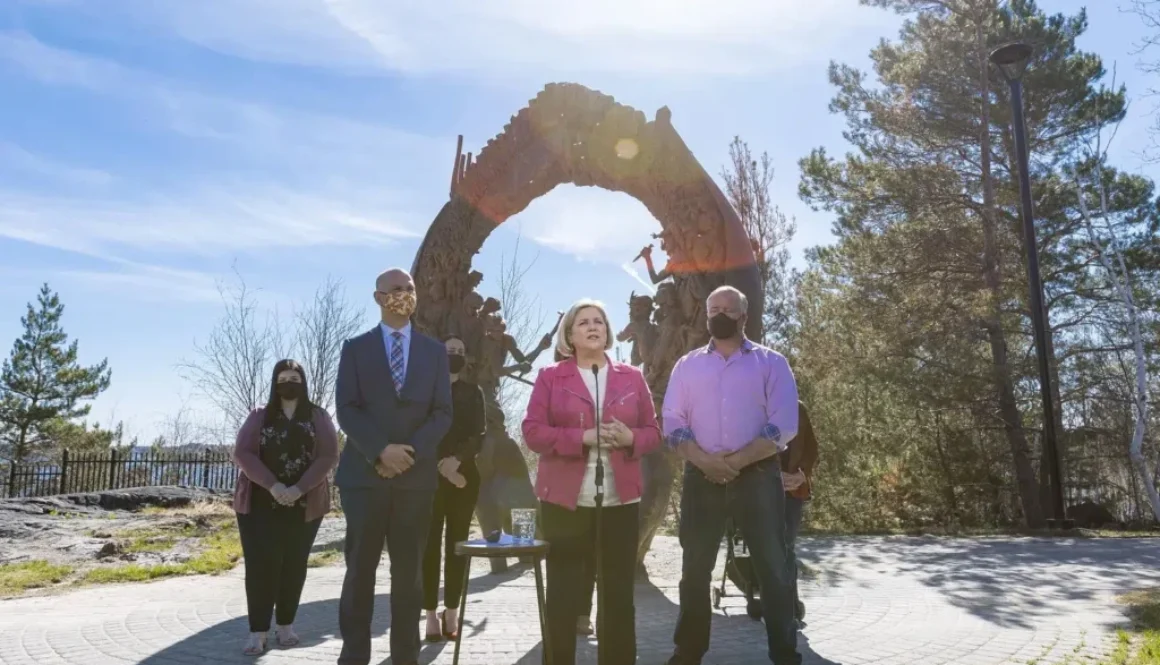
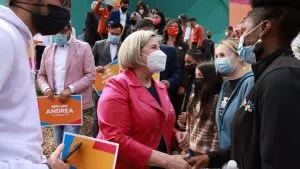
NDP leader Andrea Horwath has released her party’s platform for northern Ontario.
Health care plays a prominent role.
It includes hiring 300 more doctors, including one hundred specialists and 40 mental health practitioners.
“You have not gotten your fair share on so many fronts, and we’re here to say you can get your fair share with the government that pays attention to your needs,” says Horwath.
Horwath is also promising to deal with the opioid crisis with investments in treatment programs and revamping the Northern Ontario Travel Grant program.
Other components include creating more training and job opportunities in the trades, mining and film and television sector.
An NDP government would also make high-speed Internet available across the north by 2025.
Ontario Liberal leader Stephen Del Duca has released his full campaign platform.
It’s labelled A Place to Grow.
He says it tackles the province’s affordability crisis and will help families get ahead.
“Our message to the people of Ontario is that this plan will give them the relief that they deserve. And the choice on June 2 will be theirs,” says Del Duca.
The Liberal plan is fully costed.
Del Duca says it also paves a way for Ontario’s budget to be balanced by the 2026-27 fiscal year.
Green Party leader Mike Schreiner wants to give first-time homebuyers a level playing field.
Schreiner says if elected premier, he will put the brakes on wealthy speculators and corporations, which he says are driving up the costs of homes across the province.
“We will bring in a multiple homes speculation tax and a vacant home speculation tax. The clampdown on the rampant speculation happening in the housing market,” says Schreiner.
Schreiner will also make home inspections mandatory at the seller’s expense.
Ontario PC leader Doug Ford is promising to increase the Ontario Disability Support Program by five per cent,
It will then be followed by annual increases tied to inflation.
Ford is also pledging an enhancement to a credit program geared toward low-income individuals and families.
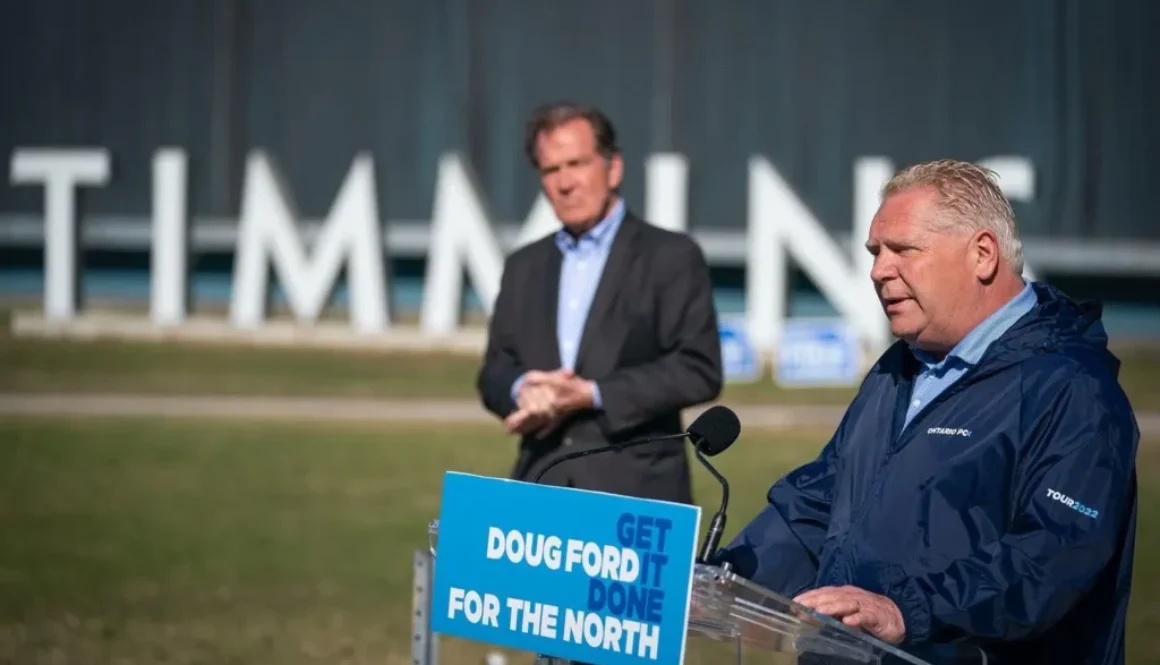
PC leader Doug Ford is defending his party’s record when it comes to the opioid crisis in northern Ontario.
Several communities have seen a rise in overdoses and related-death in the last few years.
Speaking yesterday in Timmins, Ford says tackling the issue has been a priority.
“Actually, we are getting it done. We’re the only government that made sure we had a Minister of Mental Health and Addiction. We’ve done the largest investment in Canadian history of $3.8 billion,” says Ford.
He says that is far and above what the Liberals did when they were in power.
“They did absolutely nothing. They never had a Minister of Mental Health and Addiction. They didn’t put a red cent into mental health and addiction. We’re putting $3.8 billion. I understand it’s an issue here, and we’re going to continue investing and make sure that we help people that have an addiction or have any mental health issues.”
The budget brought forward before the election call included an investment of $204 million into mental health programs.
Recently, a report issued by the Northern Policy Institute presented to local leaders concluded that local municipalities are finding themselves cash strapped in dealing with homelessness, addictions and mental issues.
Analyst and Author Holly Parsons, “All health units in northern Ontario have seen a general increase in opioid-related emergency department visits, with more drastic increases experienced in Northwest Health Unit, Porcupine Health Unit and Public Health Sudbury and District.”
Parsons makes eight recommendations, including creating a northern mental health and addictions centre of excellence to address the unique challenges of service delivery in the region.
She stresses one-size-fits-all policies and standardized systems of care don’t always work up here.
It was a quiet day for the other provincial party leaders on Sunday.
NDP Leader Andrea Horwath hosted a Mother’s Day brunch in Ayr.
Green Party leader Mike Schreiner held private meetings with residents in his riding of Guelph.
Liberal leader Steven Del Duca opted to do no campaigning on Mother’s Day.
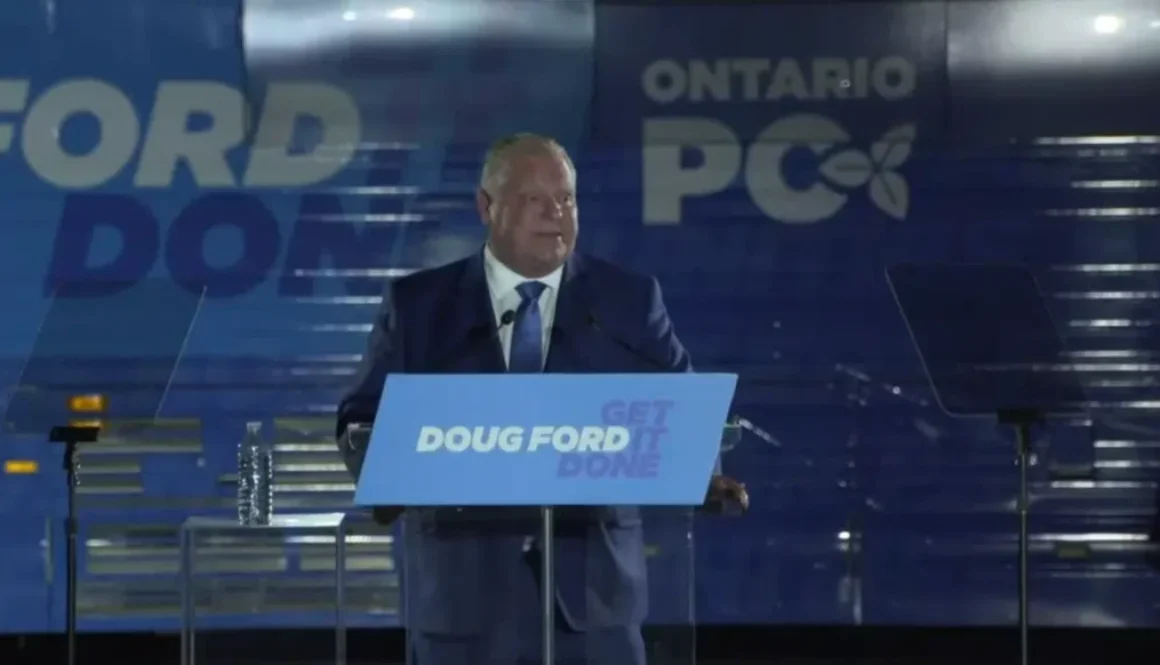
PC leader Doug Ford’s reelection bid is now underway as the campaigning toward the June 2 election officially got underway on Wednesday.
Addressing supporters in Etobicoke last night, Ford says he’s ready to back his campaign slogan, Get it done.
“Friends, it’s time to roll up our sleeves and get to work and say yes to more jobs, more homes and more roads, more highways and public transit, and more money back into your pocket,” says Ford.
Ford labelled the NDP as ‘the party of no’ while criticizing the Liberals for wasting tax dollars, leaving health care on the brink of collapse, and stalling the economy while they were in power.
Supplied photo Ontario NDP
NDP leader Andrea Horwath warns of more cost-cutting if the PCs receive a second mandate.
“So the first job, the most important thing that we can do in this election is to make sure Doug Ford does not get a second term so that the Conservatives can’t make even more cuts that hurt people,” says Horwath.
Horwath says the NDP is the best party to get that done.
She notes the party finished first or second in one hundred ridings in the last election.
Photo courtesy Ontario Liberal Party/Facebook
Education was top of mind as Liberal leader Steven Del Duca kicked off his campaign.
He is promising funding that will lead to the construction of 200 new schools and the upgrade of 4,500 others.
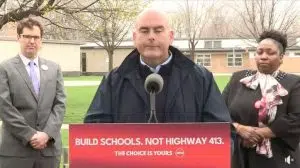
He says the $10 billion will come from cancelling the planned construction of Highway 413 in southern Ontario.
“From my perspective as a dad with kids in the system, the fact that Doug Ford wants to invest at $10 billion on the 413, instead of making sure that our kids attend state of the art schools really underscores how frankly he is not up to the job,” says Del Duca.
Del Duca says he would invest that $10 billion back into the education system within the first 100 days of taking office.
Supplied photo/Green Party of Ontario
While the other party leaders will travel by bus across Ontario, Green Party leader Mike Schreiner is going electric.
He unveiled his campaign and the electric vehicles he will use to tour the province.
Schreiner says running to earn your vote, not buy it.
“Gimmicks are not going to solve the challenges we face in this province. Gimmicks are not going to address the climate crisis and leave a livable future for our children. Gimmicks are not going to provide the housing solutions,” says Schreiner.
On the campaign trail today, Horwath will unveil her party’s plan to expand health care coverage in the province while she campaigns in the Scarborough area.
Del Duca makes a campaign announcement of his own in Woodbridge.
Schreiner talks housing in Waterloo and takes part in a candidate’s debate in his Guelph riding tonight.
The itinerary for PC leader Doug Ford was not immediately available.
The Doug Ford government has reportedly underspent by $5.5 billion this fiscal year that wraps up at the end of March.
The Financial Accountability Office that oversees government wallets, reported that the province spent $119.9 billion over the first three quarters of the 2021-22 fiscal year, which works out to be $5.5 billion less than planned.
When broken down even further, there was less spending from April to December and that health care had $1.3 billion that wasn’t spent in the allocated funds.
The financial watchdog also noted that there is over three billion dollars still available for a limited time in the Contingency and Time Limited Covid 19 funds.
Also included in their report was their prediction that spending will increase in the fourth quarter;
…expects that the pace of spending will increase due to the impact of the Omicron wave of the COVID-19 pandemic on the health sector and the introduction of new fourth quarter spending programs.
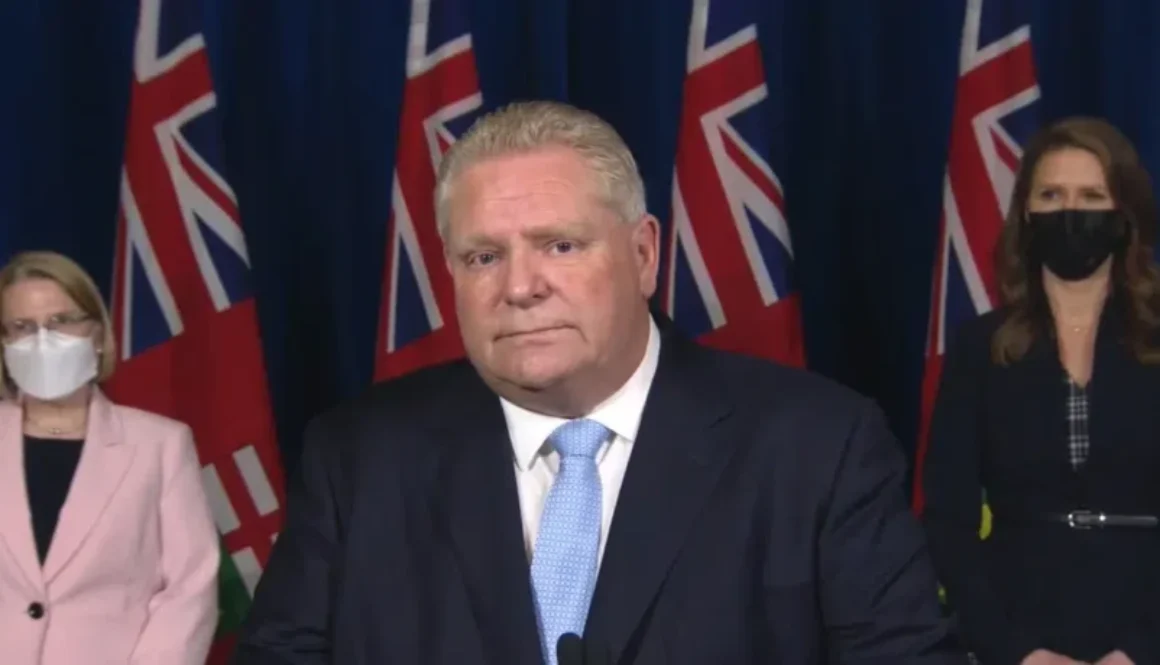
A State of Emergency has been declared in Ontario by Premier of Ontario, Doug Ford.
Ford has called the protest in Ottawa “an illegal occupation”.
The Cabinet will convene on Feb 12 to “urgently enact orders that will make crystal clear it is illegal and punishable to block and impede the movement of goods, people and services along critical infrastructure”
Ford states that the declaration will include;
protecting international border crossings, 400-series highways, airports, ports, bridges and railways. It will also include protecting the safe and essential movement of ambulatory and medical services, public transit, municipal and provincial roadways, as well as pedestrian walkways,
During his statement, Ford called the protests a “siege.”
When speaking about the situation he said; “It’s an illegal occupation. This is no longer a protest” and he directed comments to to “…please, go home”
The Premier also discussed the repercussions for any violators;
“Fines for non-compliance will be severe, with a maximum penalty of $100,000 and up to a year imprisonment. We will also provide additional authority to consider taking away the personal and commercial licenses of anyone who doesn’t comply with these orders.”
Both OPP and RCMP have provided more officers on the streets and other aides.
During the press conference, Doug Ford also spoke about the Chief Medical Officer of Health’s future plans for mandates and restriction milestones.
He said that Dr. Kieran Moore is developing a plan that would end the use of vaccine passport, but no details or timelines were given. Ford also noted that the province is on track to with the next wave of eased restrictions (Feb. 21st), he didn’t indicate that anything would be moved ahead of schedule yet.
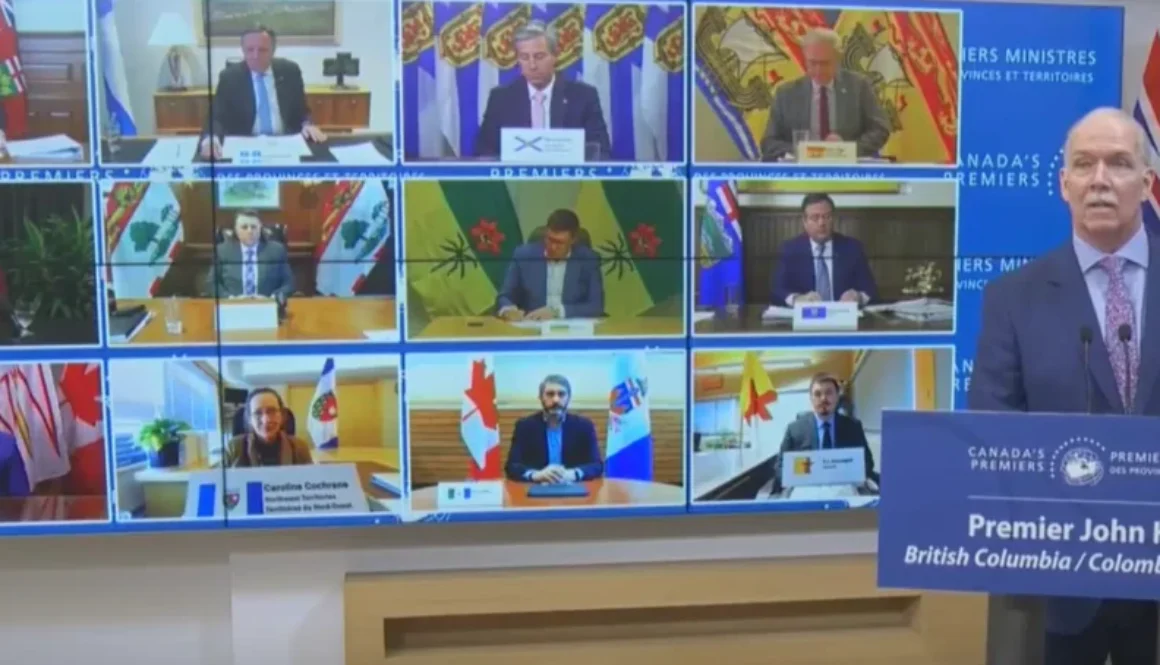
Canada’s premiers have renewed calls for an increase in federal health care transfer payments.
British Columbia Premier John Horgan serves as chair of the Council of the Federation, which comprises all 13 provincial and territorial premiers.
“Of course, the global pandemic has tested us all. It has strained our public health care systems right across the country,” Horgan said at a virtual news conference on Friday.
“All 13 premiers agree we need a significant long-term increase in funding from the federal government to meet the challenges of coming out of the pandemic and ensuring that the services that people expect and deserve in Canada are uniformed from coast to coast to coast.”
Federal funding has been eroded over the last 50 years, now only covering about 22 per cent of the total funds needed to provide services in some jurisdictions, said Horgan.
Premiers are looking for a First Ministers meeting to ensure a boost in these transfers will cover 35 per cent of provincial-territorial health care costs.
“Through the pandemic, the federal government has been an outstanding partner, ensuring that we’re supporting businesses, workers and communities so we can all weather COVID-19, and now provinces and territories are coming together once again to call on the federal government to join with us and renew the partnership for public health care in Canada,” Horgan remarked.
Larger health transfers would be expected to improve services, wait times, human resources in the health care system. Additionally, Horgan said this would ensure they can provide high-quality diagnostics to address diseases like COVID-19 and cancer.
Prime Minister Justin Trudeau has not made a statement on the Council of the Federation’s latest announcement.
Ontario is the only one left without a child care deal.
Nunavut and the Federal Government have signed a deal for the $10 a day child care. They were the second last place in Canada to sign on the dotted line, other than Ontario.
The last time Premier Doug Ford spoke about the deal was back in November 2021 where he was quoted as saying
We’ll strike a deal, but I’m not making a bad deal just for the sake of making a deal… I want the same deal that he has (in reference to Quebec Premiere François Legault). He has minimum, minimum strings attached and they are getting a lot more per capita… I am not going to get the short end of the stick on this
Quebec’s child care is already heavily provincially subsidized.
The average cost of child care in Ontario is just under $13,000, or about $53 a day.
The way that cases are being reported in school is changing ahead of students returning Jan.17.
With the played down notification on Monday of children going back to school, the province won’t be reporting cases in schools anymore.
A document released by the province indicates that PCR tests will be rationed out. They will only be provided to symptomatic elementary and secondary students, staff who become symptomatic at school.
Students/staff in the same class as a symptomatic cohort or a positive covid case will not be offered self collection kits either. Nor will entire classes be dismissed, instead class or school closures will be based on operational needs.
Public health units will no longer be dismissing cohorts. Any dismissals or closures of a school or child care will be contingent on operational requirements determined by the school board, school and/or child care operator.
Given the widespread transmission and inability to test all symptomatic individuals, schools will not be routinely notifying students/pupils in classes with a positive case, or if a child/student or staff is absent due to symptoms associated with COVID-19.
Those who are 12 years and older and partially (or none) vaccinated must isolate for 10 days. The isolation starts on either the first day of symptoms or the date of a positive test, which ever came first.
If someone is 12 years and older and fully vaccinated, isolation is five days from first symptoms or positive test results; again which ever occurred first. These individuals can exit isolation 24 hours after symptoms have improved.
For students 11 years old and younger, they can exit isolation after five days once symptoms show improvement.
These updates also include child care settings within schools and are also applicable to the children in attendance as well as the workers.
We use cookies and similar technologies to ensure that our website functions properly and to make your use of our website more convenient. We also use third party cookies and similar technologies that are managed by our business partners or service providers, to develop and improve our website, and to help you see ads on our website and other websites that are matched to your interests. You should be able to disable most cookies associated with our website via your browser settings but this may affect the functionality of the website. You can also opt out of third-party cookies used for targeted advertising by adjusting your cookie settings. To learn more about how we use cookies and how to manage them please see our Privacy Policy or contact us at privacy@ocil.ca.
FunctionalAlways active
The technical storage or access is strictly necessary for the legitimate purpose of enabling the use of a specific service explicitly requested by the subscriber or user, or for the sole purpose of carrying out the transmission of a communication over an electronic communications network.
Preferences
The technical storage or access is necessary for the legitimate purpose of storing preferences that are not requested by the subscriber or user.
Statistics
The technical storage or access that is used exclusively for statistical purposes.The technical storage or access that is used exclusively for anonymous statistical purposes. Without a subpoena, voluntary compliance on the part of your Internet Service Provider, or additional records from a third party, information stored or retrieved for this purpose alone cannot usually be used to identify you.
Marketing
The technical storage or access is required to create user profiles to send advertising, or to track the user on a website or across several websites for similar marketing purposes.