


In a few hours, we hit the spring reset.
Since December we’ve been slowly getting back toward longer days, but tomorrow Friday, March 20 at 9:46AM is the exact moment the end of winter is here! It is the vernal equinox, the instant the Sun is directly above the equator and crosses into our half of the sky.
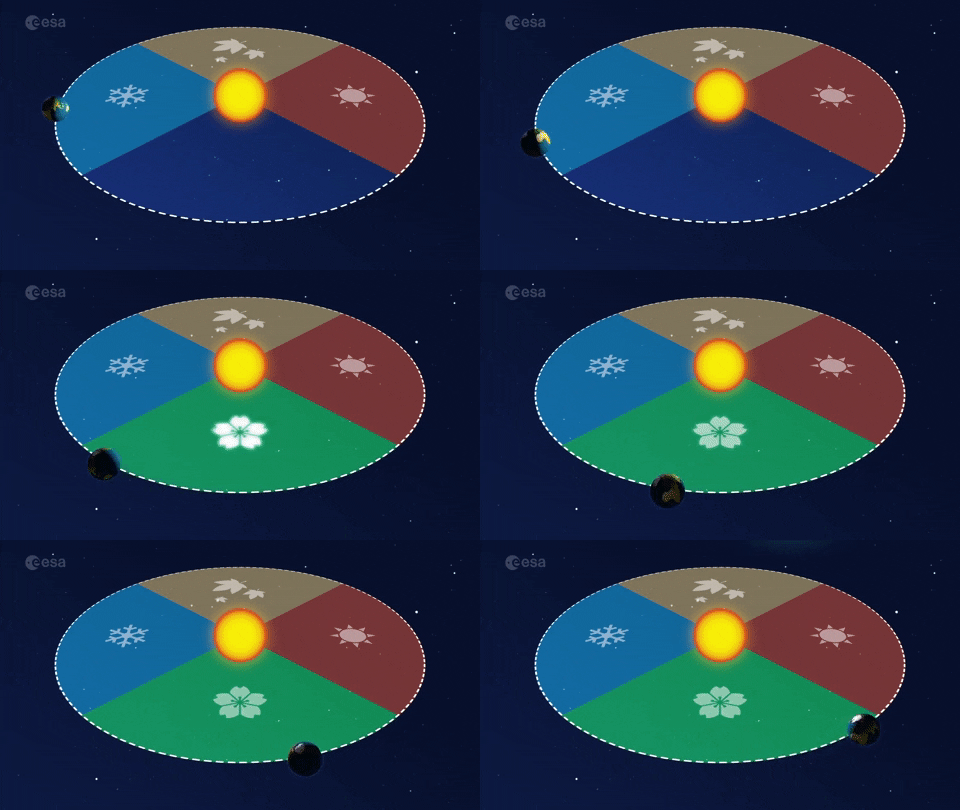
Astronomically, Earth is tilted about 23.4°, and twice a year that tilt lines up so neither hemisphere leans toward the Sun. That’s what makes the Sun’s path jump north now and south again in September.

You’ll hear that “day and night are exactly equal everywhere.” Close, but not quite. Because sunrise/sunset are defined by the Sun’s upper edge, and our atmosphere bends light a little, daylight actually runs a bit longer than 12 hours on the equinox. The true “equal‑day‑equal‑night” (the equilux) tends to land a few days earlier, roughly around March 17.

Dryden is gaining daylight fast, around the equinox you’re looking at about 7:15 a.m. sunrise and 7:24 p.m. sunset on March 20, give or take a couple of minutes depending on your exact block and horizon. That’s roughly 12 hours, 9 minutes of daylight.
Fort Frances is on a similar path and typically adds about four minutes of daylight compared to the previous day this week. If you’ve noticed mornings a little earlier and evenings lingering past 7:20, you’re not imagining it.
And for sky‑watchers from Kenora to Rainy River, today’s a perfect compass check, on the equinox, the Sun rises due east and sets due west, a once‑each‑half‑year alignment that’s great for lining up trails, docks, or just your sense of direction.
From here, the light keeps staying up every single day a little longer until the June 21 solstice, our longest day, when summer officially enters the chat!
So yes, the Sun’s been quietly clawing back time since December. But at 9:46AM, it wins. If you’ve got some time around then, step outside. Face east. Feel that seasonal click as the balance shifts and let the longer evenings start to do their work.