

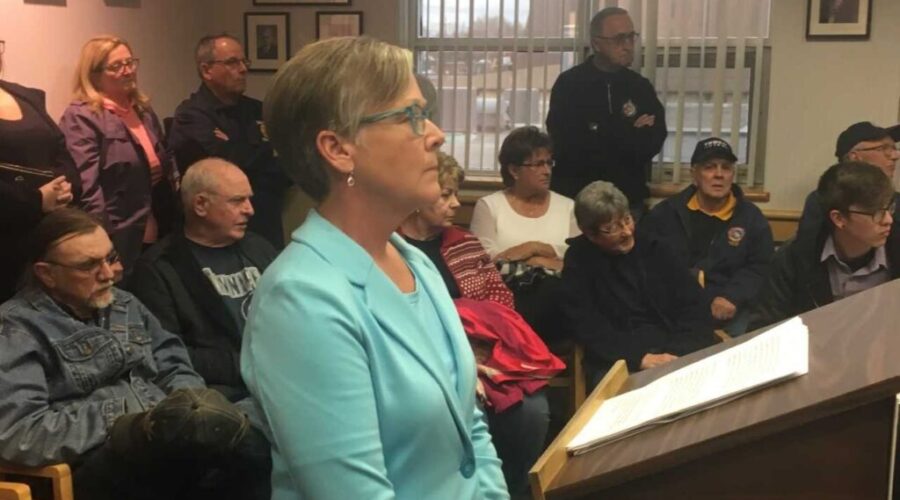
It started out as a presentation of some 1,200 signatures on a petition, but it turned into a lengthy, frank and sometimes emotional discussion on how the volunteer firefighters issue got to where it is now.
A special meeting was held Tuesday at City Hall to discuss the four firefighter delivery models facing Council, however was altered to accommodate the petition led by Pam Miller.
The petition ended up having several signatures stricken off the record as they weren’t eligible, resulting in just less than 1,000.
Miller says Dryden residents are concerned about the current level of service, calling for the City and the Firefighters Association to return to the negotiation table.
However, it doesn’t appear Council is willing to do so.
A motion to resume talks, presented by Mary Trist was voted down.
Councillor Nick Beyak says they are looking at a new delivery model because they can’t have another work stoppage.
Beyak says the community was exposed and people were put at risk when volunteer firefighters didn’t sign return to work forms and that’s why they opted to go in a different direction.
Roger Valley believes they should hit the reset button and sit back down, noting a petition like this has never been seen.
Norm Bush says Council needs to take-in all of the recent information and meet with Chief Administrative Officer Roger Nesbitt.
Yesterday’s meeting ended up being a back-and-forth between Council, members of the Association and concerned citizens.
It started out as a dispute over alcohol in the Fire Hall club room.
It was made public that two Dryden police officers were brought by city staff to inspect the room, following the approval of a new municipal alcohol policy.
Beyak says the officers were brought-in because the City had concerns about a potential confrontation with volunteer firefighters.
Beyak says that the officers then called two more officers for back-up.
Volunteer firefighters in attendance disagreed, saying that they had a civilized conversation with police.
Beyak then striked back by saying the Association was “looking for a fight.”
After some lengthy debate, it was agreed on both sides that firefighters were meeting all of regulations set by the City and alcohol no longer was the issue in the dispute.
It was then shared that it was a Human Resources issue, with some concerned about the leadership of Chief Ryan Murrell and others upset with a City refusal to reinstate three dismissed firefighters.
Both sides agreed they had positive talks to return to work, however the Association claims that the final terms were changed and they had a lack of trust and that’s why they decided to not sign the paper work.
Association members added that some members didn’t resign, stressing they wanted to return to work, but they didn’t receive the proper paperwork.
CAO Roger Nesbitt says it was his choice and his choice alone on who was allowed to return.
Some in attendance were upset that they didn’t get an invite, noting they have a perfect record, and didn’t receive any paperwork terminating their service.
15-members of the Association have agreed to return to work, or are currently back with the fire department.
The Association was also upset that Human Resources concerns were never addressed by the Manager in charge with the City of Dryden.
The City of Dryden is now looking at four service delivery models, with a plan to decide on one at the May 28th Council meeting.
One concerned citizen in attendance credited Council for getting the City back on track financially, noting he can’t imagine spending more money on an unknown and unproven fire model, when the current system isn’t broken.
Here are the proposed models:
Model #1 – 2018 Budget (current)
Full cost of department – $808,507
Cost per Household – $228.33
Cost per Capita – $104.34
Percentage of Budget – 2.89
Model #1 was the model in place prior to the current work stoppage. This utilizes trained volunteers at very high numbers and they also contribute to other community and safety events, including fireworks. There is a 9 minute average response time in the Pumper and in-house ability for large incidents. This model would have a Fire Underwriters Society rating of 3B. Bunker gear replacement for 55 individuals can also be very expensive.
Model #2 – Volunteers / Work Experience Program
Full cost of department – $805,873.24
Cost per Household – $227.58
Cost per Capita – $104.00
Percentage of Budget – 2.88%
Difference from 2018 Budget – (-$2,633.76)
Cost per Household Decrease – $0.74
Funding options include any or a combination of the following:
– Savings within city’s overall budget
– Reserves
– Estimated Tax Increase – 0.39 per cent
The work experience program would bring graduates from pre-service fire colleges in Ontario to work and live in Dryden. Fire departments in British Columbia use a similar model, where 50 per cent of their applicants come from Ontario.
This model would have an 8 minute average response time in the Pumper. The FUS rating will improve to 2 with potential to improve to 1. A living allowance is also part of this model for work experience program participants.
Model #3 – Paid on Call Volunteers
Full cost of department – $946,899
Cost per Household -$267.41
Cost per Capita – $122.20
Percentage of Budget – 3.38
Difference from 2018 Budget – $138,392
Cost per Household increase – $39.08
Funding options include any or a combination of the following:
– Savings within city’s overall budget
– Reserves
– Estimated Tax Increase – 0.98 per cent
This model utilizes trained volunteers at very high numbers and they also contribute to other community and safety events, including fireworks. This model has a 9 minute average response in the Pumper and in-house ability for large incidents. The model would have a FUS rating of 3B. Bunker gear replacement for 55 firefighters is also very expensive. A heavy reliance on employers for response during daytime hours.
Model #4 Full time / Volunteer Firefighters
Full cost of department – $1,155,082
Cost per Household – #326.20
Cost per Capita – $149.06
Percentage of Budget – 4.13
Difference from 2018 Budget – $346,575
Cost per Household Increase – $97.87
Funding options include any or a combination of the following:
– Savings within city’s overall budget
– Reserves
– Estimated Tax Increase – 2.46 per cent
This model builds retention and recruitment opportunities. There would be guaranteed daytime coverage with 3 full-time firefighters and an average response time of 7 minutes.
Financial implications – Current Budget allocation – $808,507